










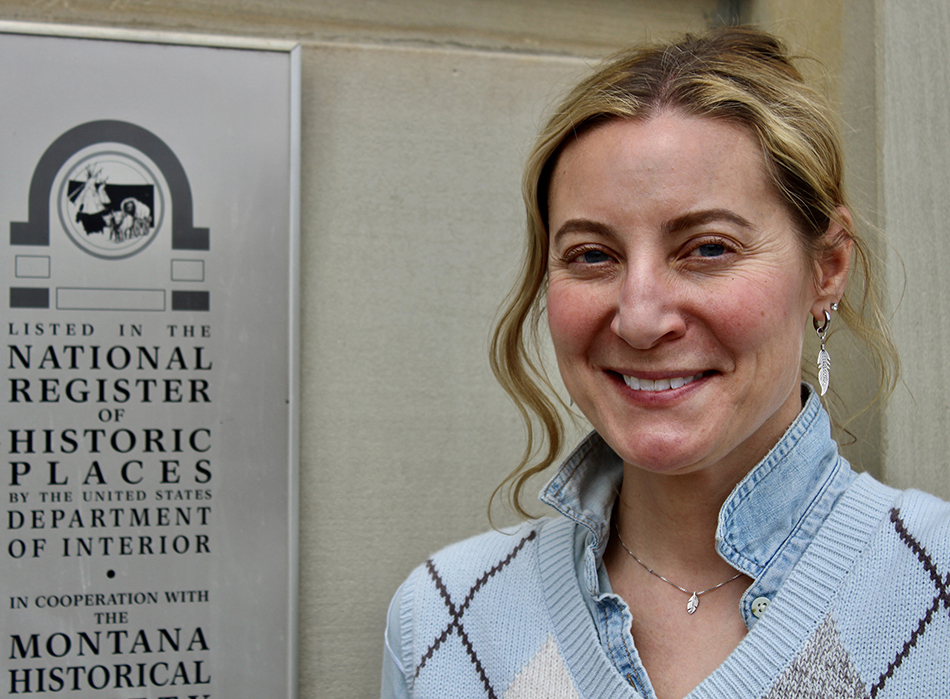
Kate McCourt, B-SB Historic Preservation Officer photo by Paul Vang
By Paul F. Vang for ButteNews.net
Kathleen (Kate) McCourt grew up in an area rich in landmarks from the Revolutionary War in the Hudson Valley of New York and has studied internationally. Since 2022, she has been bringing her background in history and archeology to her job as Historic Preservation Officer for Butte-Silver Bow. After two years in Butte, she finds her work fascinating, as she delves into what she calls, “All the crazy things that have happened here.”
Ms. McCourt (we’ll refer to her as Kate) was born in Marlboro, New York, in Hudson Valley, about 75 miles from New York City. She has a bachelor’s degree from State University of New York (SUNY) in Albany, New York. She earned a master’s degree in archeology from University College London, and a master’s Certificate in historic preservation from the University of Kentucky. She went to a field school in Cyprus where she learned, firsthand, archeological excavation.
She returned to the U.S. and did field work at Revolutionary War sites, such as Newburgh, New York, where General George Washington had colonial Army headquarters for an extended period of the war, and Portsmouth, New Hampshire, an important naval port during the Revolution.
Kate first came west in 2008 to work as a preservation specialist in Virginia City. She reflects, with a smile, that she came to Virginia City for a summer job that somehow turned into five years. She went back east in 2013, where she taught an online course on Historical Architecture for Boston Architectural College, as well as had a job with the University of Montana, based in Virginia, as a museum registrar for a collection of naval artifacts.
Kate came back to Montana in 2019, landing a job as historic preservation officer for the city of Great Falls. She found that she missed the mountain country and got a job in Helena with the Foundation for Montana History. She became the Historic Preservation Officer for Butte-Silver Bow in March 2022.
After working in Virginia City, Montana’s second territorial capitol, a town based on placer mining for gold, she considers Butte as a big jump, as a center for industrial mining and smelting “on the biggest scale.”
Kate finds Butte, with its unique and varied architecture, its important contributions to war efforts in both World Wars, and a center of organized labor, to be a fascinating place. “There are so many stories to tell,” she says.
Varied architectural styles can be found in Butte and familiarity with architecture is an important part of Kate’s job. As part of her job, she’s been through a lot of buildings in uptown Butte, including buildings with businesses on the street level and upper floors where pigeons have taken over. Much of her work is to identify significant buildings, to find money to fund preservation projects, and often to keep buildings mothballed for future purposes. A big challenge to this, she has found, “There are lots of absentee landlords.”
Kate enjoys working for Butte-Silver Bow, and one of her projects has been for the historic Silver Bow County Courthouse, getting a grant from the Foundation for Montana History to soon restore the revolving doors at the main entrance to the courthouse. She has other grant proposals pending with the National Park Service and Urban Revitalization Agency.
Kate has become involved with other groups. She’s serving on the Board of the Butte Cultural Heritage Center, formerly the B’nai Israel Synagogue. She’s an ex-officio, non-voting member of the board of the Butte Performing Arts Center, which operates the Mother Lode Theater. She’s also on the board of the World Museum of Mining.
Kate took the opportunity, during our interview, to mention a special event on Thursday, March 6, 6:30 p.m. The Butte Cultural Heritage Center is presenting a program on the holiday traditions of Passover, Easter, Christmas and Hanukkah, and commonalities and contrasts from the different traditions. The program will have a panel that includes Kate McCourt, as a historian, Father Patrick Beretta, a Catholic priest in Butte, Rabbi Sonia Pilz, of Congregation Beth Shalom in Bozeman, and Rev. Miriam Schmidt, pastor of All Saints in Big Sky, a shared ministry of Episcopal and Lutheran churches. Janet Cornish of the Cultural Heritage Center will be the moderator.
After spending most of her adult life bouncing around the country and the world, Kate has become a homeowner, buying a home on Butte Hill, and she is pleased that her home is on the historical register. One of her goals is to get a plaque for the house.
On a personal side, Kate loves the outdoors and the many opportunities for hiking in the Butte area. As a new homeowner, she’s also learning about gardening in Butte’s mile high cold, dry climate. She has a dog and two cats that keep life interesting. I asked if she was related to the late Frank McCourt, the Irish American teacher and writer, author of Angela’s Ashes. She says that there’s no connection, except possibly in the distant past in Ireland. She did say, however, that her grandfather once met Frank McCourt, greeting him, “Mr. McCourt, I’m Mr. McCourt,” and they had a cordial conversation following that introduction, with Kate also shaking the author’s hand.
After two years as the Historical Preservation Officer for Butte-Silver Bow, Kate McCourt reflects, “I had big shoes to fill when I took this job,” referring to her predecessor, Mary McCormick. She adds, “The more I know about Butte, the more I love it. I’m proud to live here.”
